From Spring Boot and Microservices to Cloud and Kafka — The Complete Backend Tech Stack That Separates Good Java Developers From Great Ones
Top Backend Technologies Every Java Developer Should Learn in 2026
From Spring Boot and Microservices to Cloud and Kafka — The Complete Backend Tech Stack That Separates Good Java Developers From Great Ones
Ask any senior Java developer what separates a junior who gets promoted quickly from one who plateaus early — the answer almost always comes back to the same thing. It is not raw coding ability. It is the depth and breadth of their backend technology knowledge.
In 2026, being a Java developer who only knows Core Java and basic Spring Boot is the equivalent of being a chef who can only boil pasta. You can technically do the job — but you are not going to be trusted with the kitchen, and you are definitely not going to be paid like a head chef.
The backend technologies for java developers landscape has expanded significantly. Microservices, message queues, caching layers, cloud-native deployment, and API gateways are no longer advanced specialisations — they are the standard toolkit of any serious backend developer. This guide breaks down exactly which technologies you need, why they matter, and how to learn them efficiently in 2026.
Why Backend Technology Choices Define a Java Developer's Career in 2026
Before getting into the specific technologies, it is worth understanding why the backend landscape has become so complex — and why that complexity is actually an opportunity for Java developers who are willing to invest in the right skills.
The Shift From Monoliths to Distributed Systems
Five years ago, most enterprise applications were monolithic — one large codebase deployed as a single unit. Today, distributed microservices architectures are the standard for any application built to scale. This shift has multiplied the number of backend technologies a Java developer needs to be productive. Where once you needed Java and a database, you now need service communication protocols, message brokers, API gateways, container orchestration, and distributed tracing.
This complexity is not going away. If anything, it is deepening as companies build increasingly sophisticated platforms. Java developers who understand these systems are extraordinarily valuable. Those who do not are increasingly limited in the roles they can access.
Salary Is Directly Tied to Technology Depth
The salary gap between a Java developer with basic Spring Boot skills and one with Spring Boot, Microservices, Kafka, Redis, Docker, and AWS expertise is not marginal — it is often double or more. Java backend training that goes beyond the basics directly translates to higher earning potential because the supply of truly well-rounded backend developers remains significantly below demand.
Companies Are Explicitly Listing These Skills in Job Postings
Browse any serious Java backend role on LinkedIn or Naukri today and count how many of these appear in the requirements: Spring Boot, Microservices, REST API, Kafka or RabbitMQ, Redis, Docker, Kubernetes, AWS or Azure, Hibernate, and SQL. These are no longer bonus qualifications — they are the base expectations for mid-level and above positions. Meeting all of them is what opens doors to the highest-paying opportunities.
The Top Backend Technologies Every Java Developer Must Know in 2026
Let's go deep on each technology — what it is, why it matters, and what level of proficiency you actually need as a Java backend developer.
Spring Boot — Still the Non-Negotiable Core
If there is one technology that sits at the absolute centre of Java backend development in 2026, it is Spring Boot. It is the framework through which everything else gets built and connected. A spring boot certification is not just a resume decoration — it signals to employers that your Spring Boot knowledge has been formally validated across the full range of its capabilities.
What you need to know goes well beyond basic CRUD application setup. Employers expect mastery of Spring MVC for RESTful API design, Spring Security with JWT and OAuth2 for authentication and authorisation, Spring Data JPA with Hibernate for database interaction, Spring Actuator for application monitoring, and Spring Batch for processing large data sets. Advanced topics like custom auto-configuration, application events, and bean lifecycle management separate the proficient from the expert.
Every other technology on this list integrates with Spring Boot in some way. Master this first — everything else builds on it.
Microservices Architecture — The Design Paradigm of Modern Java
Microservices is less a single technology and more an architectural approach — but it is one that requires a specific set of tools, patterns, and decisions that Java developers need to understand deeply. A quality microservices course covers not just how to break an application into services but how to manage the complexity that comes with that decomposition.
Key concepts include service discovery and registration with tools like Eureka, inter-service communication using REST or gRPC, API gateway patterns with Spring Cloud Gateway, distributed configuration management with Spring Cloud Config, circuit breaker patterns with Resilience4j, and distributed tracing with tools like Zipkin or Jaeger. Understanding when to use microservices — and critically, when not to — is equally important and reflects the kind of architectural maturity that senior roles require.
Apache Kafka — Message-Driven Architecture at Scale
Kafka has become one of the most important backend technologies in the modern enterprise stack. It is a distributed event streaming platform used for building real-time data pipelines, event-driven microservices, and high-throughput messaging systems. In fintech, e-commerce, logistics, and any domain where events need to be processed reliably at scale, Kafka is everywhere.
As a Java backend developer, you need to understand Kafka producers and consumers, topic partitioning and consumer groups, offset management, Kafka Streams for real-time processing, and Spring Kafka for integrating Kafka into your Spring Boot applications. This is one of the technologies that most significantly differentiates senior Java backend developers from their junior counterparts.
Redis — Caching and Performance Optimisation
Database queries are slow. Network calls are slow. Repeated computation is wasteful. Redis solves all three problems as an in-memory data store used for caching, session management, rate limiting, pub/sub messaging, and leaderboard systems. Understanding how to integrate Redis into a Spring Boot application — using Spring Cache abstraction or Spring Data Redis — is a skill that directly impacts application performance and is tested in interviews at performance-conscious companies.
Beyond simple key-value caching, Java developers should understand Redis data structures, cache eviction policies, TTL configuration, and the trade-offs between write-through, write-behind, and cache-aside strategies. These concepts appear regularly in system design interview questions for senior backend roles.
Docker and Kubernetes — Containerisation Is No Longer Optional
A Java backend developer who cannot containerise an application with Docker is increasingly at a disadvantage in 2026. Docker allows you to package your Spring Boot application with all its dependencies into a portable container that runs identically across development, testing, and production environments. Understanding Dockerfiles, multi-stage builds, docker-compose for local development, and container networking is now baseline knowledge for mid-level Java developers.
Kubernetes takes this further by orchestrating containers at scale — handling deployment, scaling, load balancing, and self-healing of containerised applications. While deep Kubernetes expertise is more of a DevOps or senior engineer responsibility, Java backend developers who understand pod specifications, services, config maps, secrets, and basic deployment manifests are significantly more productive in cloud-native environments.
AWS Cloud Services — Java in the Cloud
Amazon Web Services remains the dominant cloud platform in 2026, and Java backend developers who can deploy, configure, and optimise their applications on AWS are consistently in higher demand than those who cannot. The core services every Java developer should understand include EC2 for virtual servers, S3 for object storage, RDS for managed relational databases, Lambda for serverless functions, SQS and SNS for messaging, and API Gateway for managed API endpoints.
Spring Boot's compatibility with AWS services through libraries like AWS SDK for Java and Spring Cloud AWS makes this integration relatively accessible. The java backend training programs that include practical AWS labs give graduates a meaningful advantage over candidates with purely theoretical cloud knowledge.
Hibernate and Advanced Database Skills
While most Java developers know the basics of Hibernate, the gap between basic and advanced Hibernate knowledge is significant — and it shows up directly in application performance. Advanced topics include second-level cache configuration, batch processing for bulk operations, fetch strategy optimisation to prevent the N+1 query problem, criteria API for dynamic query building, and database-specific optimisations.
Beyond Hibernate, Java backend developers should be comfortable with both SQL and NoSQL databases. MySQL and PostgreSQL for relational data — including indexing strategies, query optimisation, and stored procedures. MongoDB for document-based storage in applications that benefit from flexible schemas. Redis for in-memory data as discussed above. Understanding which database type suits which problem is a mark of backend maturity.
REST API Design — Beyond the Basics
Almost every Java backend developer knows how to build a basic REST API. Far fewer know how to build one well. Advanced REST API skills that employers look for include versioning strategies, HATEOAS for hypermedia-driven APIs, rate limiting and throttling implementation, proper use of HTTP status codes and error response formats, pagination and filtering patterns, API documentation with OpenAPI and Swagger, and API security beyond basic JWT — including OAuth2 flows and API gateway-level security.
These are the details that distinguish an API that merely works from one that is production-ready, scalable, and maintainable by a team over time.
GraphQL — The Alternative API Paradigm
REST is still dominant, but GraphQL has established itself as a serious alternative for specific use cases — particularly in applications where clients need flexible data fetching. Java backend developers working in product companies, especially those with mobile applications or complex frontend requirements, increasingly encounter GraphQL. Understanding the query language, schema definition, resolvers, and how to implement GraphQL with Spring Boot using libraries like Netflix DGS or GraphQL Java gives you versatility that pure REST developers lack.
gRPC — High-Performance Service Communication
In microservices architectures where inter-service communication happens thousands of times per second, REST over HTTP/1.1 can become a performance bottleneck. gRPC — Google's open-source remote procedure call framework — uses Protocol Buffers for serialisation and HTTP/2 for transport, delivering significantly higher throughput and lower latency than REST. Understanding gRPC concepts, proto file definition, and Spring Boot gRPC integration is increasingly valued in companies with high-performance microservices requirements.
How Java Backend Training and Spring Boot Certification Accelerate Your Career
Knowing which technologies to learn is one thing. Knowing how to learn them effectively — and prove that knowledge to employers — is another. This is where structured java backend training and formal spring boot certification play a critical role.
Why Self-Study Alone Often Falls Short
The temptation for many developers is to piece together knowledge from YouTube tutorials, Stack Overflow, and documentation. This approach can work — but it is slow, inconsistent, and leaves significant gaps. More importantly, self-study rarely produces the kind of project portfolio that convinces a hiring manager you are production-ready. Employers are not looking for developers who understand the theory — they are looking for developers who have actually built systems.
What Good Java Backend Training Looks Like
The most effective java backend training programs are structured around progressive complexity. You start with Spring Boot fundamentals and build a simple REST API. Then you add a database layer with Hibernate. Then you introduce authentication with Spring Security. Then you containerise with Docker. Then you break the monolith into microservices and add Kafka for event-driven communication. Each stage builds on the previous one, and each stage produces a component you can show in an interview.
This progression — theoretical introduction followed immediately by practical implementation — is what separates training programs that produce hireable developers from those that produce certificate holders who cannot code in front of an interviewer.
The Value of Spring Boot Certification
A spring boot certification validates your knowledge formally and signals to employers that your skills have been assessed against an industry standard rather than self-reported. For candidates without a CS degree or with non-traditional backgrounds, certification carries particular weight — it provides an objective credential that compensates for the absence of a university transcript.
Beyond the credential itself, the process of preparing for a spring boot certification forces you to revisit and solidify concepts you may have learned superficially. Many developers find that certification preparation reveals gaps in their understanding they did not know existed.
The Role of a Microservices Course in Career Progression
For Java developers looking to move from junior to mid-level or from mid-level to senior, a dedicated microservices course is often the most direct lever available. Microservices architecture is consistently one of the most requested skills in senior Java backend roles, and it is one of the hardest skills to develop without structured guidance because the complexity of distributed systems requires understanding failure modes, consistency trade-offs, and communication patterns that are difficult to encounter in tutorial projects.
A good microservices course uses real-world scenarios — breaking a monolithic e-commerce application into services, implementing saga patterns for distributed transactions, building an API gateway — to give you the kind of experience that makes you credible in a system design interview.
Best Backend Technologies for Java Developers 2026 — Where to Learn Them in Mumbai
For Java developers in Mumbai looking to build or deepen their backend technology stack, structured bootcamp training remains the fastest and most reliable route to job-ready skills.
Why Mumbai Remains One of India's Best Cities for Java Backend Careers
Mumbai's concentration of BFSI institutions, global MNC technology centres, and product-focused startups creates a consistently strong demand for Java backend developers. Companies across Andheri, BKC, Powai, Thane, and Navi Mumbai are actively hiring developers with the exact backend technology stack described in this guide. Training in Mumbai means you are not just learning in a vacuum — you are preparing for a specific, vibrant, and accessible job market.
The JustAcademy Full Stack Java Developer Bootcamp in Mumbai is one of the most comprehensive programs available for Java developers who want to build a complete, market-ready backend technology stack. The curriculum covers Core Java, Spring Boot in depth, microservices with Spring Cloud, Hibernate and database management, Docker and deployment fundamentals, and REST API design — all through classroom-based training with real project work.
The program's placement cell connects graduates with hiring partners across Mumbai, and the combination of technical depth, hands-on projects, and placement support makes it one of the most effective pathways to a high-paying Java backend role in 2026.
Explore the Full Stack Java Developer Bootcamp in Mumbai
Ready to take the first step? Register for a free demo session and evaluate the program before making any commitment.
Register for a Free Demo — No Commitment Required
Explore More Bootcamps at JustAcademy Mumbai
For developers or testers looking to specialise in quality engineering and automation, this bootcamp covers Selenium, TestNG, API testing, CI/CD integration, and end-to-end automation frameworks with real project experience.
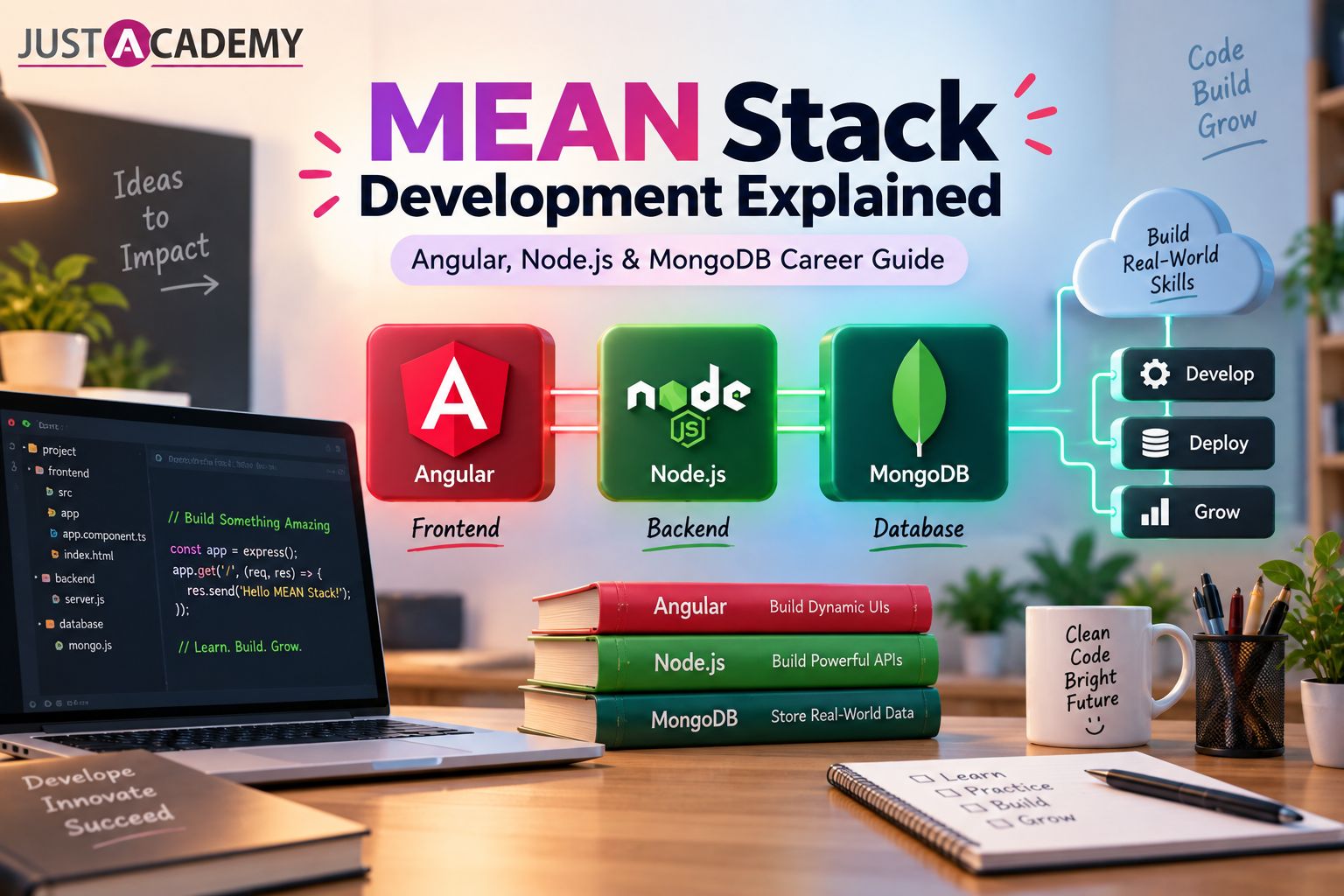
A complete JavaScript full stack program covering MongoDB, Express.js, React.js, and Node.js. Ideal for those who want to build full stack applications in the JavaScript ecosystem with classroom training and placement support.
For those drawn to data-driven careers, this bootcamp covers Python, SQL, Power BI, and machine learning fundamentals with real-world datasets and structured project work designed to build a job-ready analytics portfolio.
The Takeaway — Build the Stack, Build the Career
The best backend technologies for java developers 2026 are not a mystery. They are Spring Boot, Microservices with Spring Cloud, Kafka, Redis, Docker, Kubernetes, AWS, advanced Hibernate, and clean REST API design. Together, they form a backend technology stack that makes a Java developer genuinely valuable — not just employable, but competitive for the highest-paying roles in the market.
The developers who invest in building this full stack of backend knowledge through quality java backend training, pursue spring boot certification to validate their skills, and complete a comprehensive microservices course are positioning themselves at the front of the queue for the best Java backend roles in 2026 and beyond.
The technology is not the barrier. The willingness to learn deliberately and build systematically is what separates the developers who break through from those who stay stuck.
Why Backend Technology Choices Define a Java Developer's Career in 2026
The Top Backend Technologies Every Java Developer Must Know in 2026
How Java Backend Training and Spring Boot Certification Accelerate Your Career
Best Backend Technologies for Java Developers 2026 — Where to Learn Them in Mumbai